
Key takeaways
- Most failed monday.com rollouts are a workflow design problem, not a platform problem.
- The clearest warning sign: teams quietly go back to spreadsheets, Slack and email for anything that matters.
- Four patterns show up in nearly every stalled implementation: feature-first builds, no named system owner, automation bolted on late, and adoption treated as a training issue.
- A five-question diagnostic can show in minutes whether your setup is fixable or needs a rebuild.
- Most rescues do not start from zero. They re-map the workflow and add the automation layer that was skipped the first time.
If your monday.com rollout is six months old and people have quietly gone back to spreadsheets, Slack threads and email for the things that actually matter, you are not dealing with a training problem or a "the team just needs more time" problem. You are dealing with a design problem: the system was built as a board, not a workflow, and boards do not survive contact with a busy team.
That is the pattern behind almost every stalled or abandoned monday.com implementation we have been brought in to look at. Not a bad platform choice. Not a lazy team. A system that was configured to look right in a demo but was never designed to carry the real weight of how the business runs.
What does a failing monday.com implementation look like at six months?
It rarely looks like total abandonment. It looks like partial abandonment, which is harder to notice and harder to fix:
- Some teams still update their boards, while others have quietly drifted back to their old tools for anything that matters.
- Status meetings still happen because nobody trusts the dashboard to be current.
- New hires are shown the "official" system, then pulled aside and shown how things actually get done.
- Leadership still asks for a manually compiled report because the automated one does not reflect reality.
- Automations exist but only cover the easy 20% of the process. The messy parts are still manual.
If two or more of these are true, the implementation is not failing because of the platform. It is failing because of what was built on top of it.
Why is a monday.com board not enough on its own?
A monday.com board can be set up correctly, with the right columns, views and permissions, and still fail completely as a system. A board is a place to put information. A workflow is a set of rules about how information has to move, who is accountable at each step, and what happens automatically when a status changes. Most implementations stop at the first one and call it done.
A board is a place to put information. A workflow is a set of rules about how information has to move.
You can tell the difference with one question: if everyone on the team disappeared for a week, would the system still know what is overdue, who is accountable and what happens next? A well-designed workflow does. A board with colour-coded statuses does not. It just displays whatever a human remembered to update.
What are the four patterns behind failed implementations?
In the rescue and second-opinion engagements we run, the same four issues show up again and again, usually in combination.
1. Built by feature, not by process
The build started from "here is what monday.com can do" instead of "here is how this specific process actually runs, including the exceptions." That produces a system that demos beautifully and then breaks the first time a real edge case shows up: a deal that needs a non-standard approval path, a client with a different onboarding sequence, or a request that does not fit any of the dropdown options. When the system cannot handle the exception, people route around it, and routing around it becomes the new normal within a few weeks.
2. No owner after go-live
Someone owned the implementation project. Almost nobody owns the system afterwards. Six months in, three automations should exist that do not, two columns are dead weight nobody remembers the purpose of, and the one person who understood the original logic has moved teams. Without a named owner whose job includes maintaining and evolving the system, every implementation degrades. It is operational infrastructure that needs upkeep, not a one-time build.
3. Automation bolted on later, instead of designed in
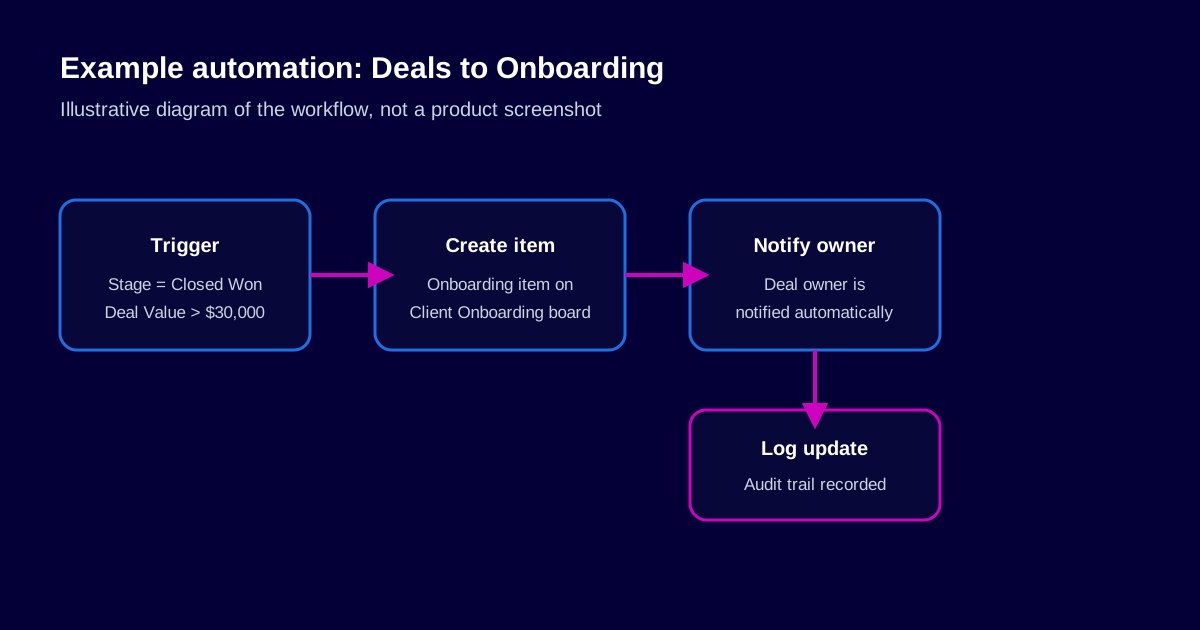
Automation gets treated as a phase-two nice-to-have: get the boards live first, and automate later. Later rarely comes, because by then the team has built manual habits around the gaps, and retrofitting automation onto an established workaround is a much harder sell than building it in from day one. The implementations that hold up treat the automation layer, whether that is monday.com's native automations or a deeper integration built in n8n or Make.com, as part of the initial design scope.
Here is what that looks like in practice: a single automation from a monday.com Deals board handling a real handoff end to end, with a conditional trigger, a value threshold, a cross-board item creation, an ownership notification and a logged audit trail.
4. Adoption treated as a training problem
Low adoption gets diagnosed as "people need more training" almost every time, and it is almost never the real issue. People do not avoid a system because they do not understand it. They avoid it because using it is more work than not using it. If updating a monday.com board takes longer than sending a Slack message, the Slack message wins, every time, regardless of how much training happened. Adoption is a design outcome, not a communication outcome.
What does a failed implementation actually cost?
The cost rarely shows up as a single line item, which is exactly why it survives so long uncorrected. It shows up as the hours a manager spends compiling a status report the system was supposed to generate automatically. As a forecast that leadership quietly discounts because everyone knows the pipeline data is stale. As the risk concentrated in the one person who still understands how the boards were meant to work. And as a second, informal system (the spreadsheet, the shared inbox, the recurring status call) that the business keeps paying for in time, even after it stopped paying for it in software.
What does a durable implementation look like?
The engagements that are still fully in use a year later share a few traits. The workflow was mapped, including the exceptions, before a single board was built. Automation was part of the initial scope, not an add-on. Someone inside the company was named as the system owner before the project closed, with a plan for how the system would keep evolving. And adoption was measured by whether the system was actually less work than the old way, not by how well the training session went.
None of that is exotic. It is a different starting point: process first, platform second. It is the difference between an implementation that is still running the business at month twelve and one that has quietly been abandoned by month six.
How do you check your own monday.com setup?
Run your current implementation through these five questions before deciding whether to fix it or start over.
| Question | A "yes" looks like | A "no" signals |
|---|---|---|
| Can someone new to the team see what is overdue and who owns it, without asking anyone? | Dashboards and statuses are self-explanatory and current | Tribal knowledge is doing the work the system should be doing |
| When an exception happens, does the system have a path for it? | Non-standard cases have a defined route | People route around the system manually |
| When a status changes, does anything happen automatically? | Notifications, approvals or handoffs trigger on their own | A human has to notice and act every time |
| Is a specific, named person responsible for maintaining this system today? | There is a clear owner with time allocated to it | Ownership ended when the project closed |
| Is using the system actually faster than the old manual way, in practice? | The team prefers it because it saves them time | The team tolerates it, or avoids it, out of obligation |
Two or more "no" answers mean the platform is not the problem. The design is.
What does a second opinion involve?
A second opinion is not a sales pitch disguised as an audit. In practice, it means walking through your current boards and automations against the workflow the business actually runs on, mapping where the two diverge, and coming back with a clear, honest read: what is salvageable, what needs to be rebuilt, and roughly what that would take. Where the real diagnosis is "this needs more training" rather than a rebuild, we say that too. A second opinion is only useful if it stays honest even when the fix turns out to be smaller than expected.
Frequently asked questions
Can a failing monday.com implementation be fixed without starting over?
Usually, yes. Most rescue engagements do not require rebuilding from zero. They require re-mapping the actual workflow, including the exceptions the original build ignored, adding the automation layer that was skipped, and assigning a real owner. A full rebuild is only necessary when the underlying data structure itself is broken, which is less common than people expect.
How long does it take to fix a stalled monday.com implementation?
A focused rescue engagement (diagnosis, workflow redesign, automation build and a supported rollout) typically runs four to eight weeks, depending on how many processes and departments are involved. A full original implementation usually takes several months.
Is this a sign we chose the wrong platform?
Rarely. The four patterns above show up on every major work-management platform, because they are process and ownership failures, not platform failures. Switching platforms without fixing the underlying design issue tends to reproduce the same problem on the new tool within a similar timeframe.
How do we know if we need a second opinion or just more internal effort?
If your team has already tried more training or more reminders and adoption has not moved, that is a strong signal the issue is structural, not behavioural. That is what an outside diagnostic is built to catch, because workflow gaps are hard to see from inside the process you built.
What does a monday.com rescue or second-opinion engagement cost?
It depends on how many processes and departments are affected, so we scope and quote after a short diagnostic rather than quoting blind. It is typically a fraction of the cost of a second full implementation, because most of the existing build is salvageable.
We have not implemented monday.com yet. Does any of this still apply?
Yes. Every pattern here is a design decision you can get right the first time: map the workflow and its exceptions before building boards, scope automation in from day one, name a system owner before go-live, and measure success by whether the system is actually less work than what it replaces.
Ready for a second opinion?
If two or more of the diagnostic questions above came back "no", it is worth a second opinion before you decide whether to rebuild, patch or start over. Book a diagnostic call and we will tell you which of the four patterns is driving yours.
Book a diagnostic call