
Key takeaways
- On 6 May 2026, monday.com announced it had rebuilt its platform around AI agents working alongside people, rebranding from a "work management platform" to an "AI Work Platform".
- The core capability: native AI agents that any team member can configure and direct without a technical background, plus Agentalent.ai, a marketplace for hiring purpose-built agents into defined roles.
- Useful benefits exist today. Agents can draft, qualify and process requests under supervision, but they only work well on boards that are structured clearly.
- The rollout risk is not the technology. It is switching agents on before the underlying workflow is clean enough for them to act on reliably.
On 6 May 2026, monday.com announced what it called the biggest change in the company's history: rebuilding the platform from the ground up around people and AI agents working together. If you run monday.com today, or are evaluating it, here is what actually changed and what is worth paying attention to.
What actually changed in monday.com?
The shift did not happen in one announcement. monday.com laid the groundwork in March 2026 with infrastructure that lets AI agents sign up, authenticate and operate directly inside the platform on a person's behalf. In effect, agents are treated as a new class of platform user, not just a background script. That was followed by the May relaunch as an AI Work Platform, and then Agentalent.ai, a managed marketplace where businesses can discover, evaluate and hire AI agents for defined roles, the way they would source a contractor or a piece of software.
The practical result: agents are no longer a bolt-on automation feature. They are built natively into boards, and any team member, not just an admin or developer, can configure and direct one without a technical background, according to monday.com's own rollout messaging.
What can agents actually do today?
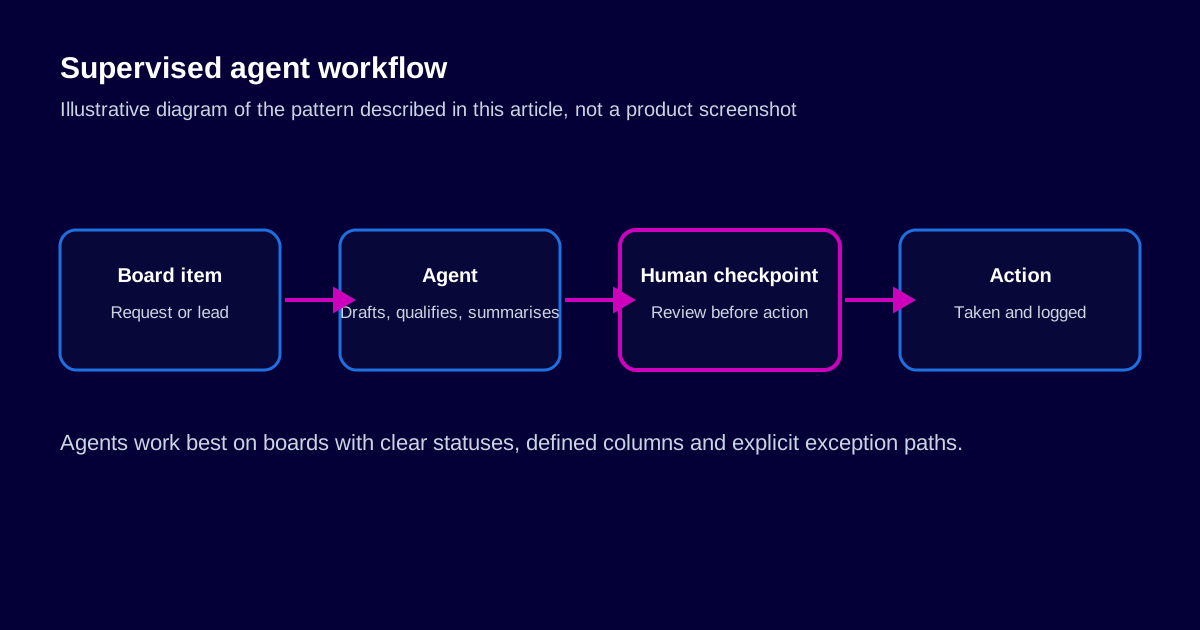
- Draft first versions of campaigns, briefs or responses based on board context, for a human to review and finalise
- Qualify inbound leads against defined criteria and route them accordingly
- Process routine requests, such as intake forms, approvals and status updates, under human supervision rather than fully autonomously
- Summarise activity across a board or project, so a manager is not compiling status updates by hand
The common thread is that these are supervised tasks, not autonomous decisions. That distinction matters more than the marketing language suggests. Today's useful version is an assistant embedded in the workflow, not an unattended operator.
What is the genuine benefit for users?
For teams already running a well-structured monday.com implementation, this closes a real gap. The busywork between "the board is updated" and "someone acts on it" (drafting the follow-up, compiling the summary, flagging the exception) can now happen inside the system instead of in someone's inbox. That is a genuine reduction in manual work, not just a new feature bolted onto the interface.
Agents are only as good as the workflow they are reading from. A messy board does not get smarter because an agent is watching it.
That is the catch worth naming. An agent configured to act on a board with unclear statuses, no defined exception path and no named owner will automate the same confusion that already existed, only faster. The four failure patterns from stalled implementations (built by feature not process, no owner, automation bolted on late, adoption treated as a training issue) apply directly to agents. The businesses getting real value are the ones whose workflow was already clean enough for an agent to read reliably.
What should you do if you are rolling agents out?
- Start with agents on boards that already have clean, structured workflows, not the boards you were hoping automation would fix.
- Keep a human checkpoint on anything customer-facing or financially consequential, at least through the first few weeks.
- Assign a named owner for each agent, the same way a durable implementation needs a named system owner. An unowned agent degrades exactly like an unowned board.
- Treat this as a phased rollout, not a switch you flip account-wide on day one.
Frequently asked questions
Do I need to rebuild my existing monday.com setup to use AI agents?
No, but a poorly structured board will limit what agents can reliably do on it. Agents work best on boards with clear statuses, defined columns and explicit exception paths. That is the same structural discipline that makes any implementation durable, agents or not.
Is monday.com's AI Work Platform included in existing plans?
Availability and pricing for AI agent features vary by plan and have changed as the rollout has progressed through 2026. Confirm current entitlements directly with monday.com or a partner before budgeting, rather than assuming last quarter's pricing still applies.
Should a small team turn this on right away?
If your current boards are already well structured, piloting agents on one or two clean workflows is low-risk. If your team is still dealing with the common implementation-failure patterns, fix the workflow first. An agent will not compensate for a board nobody trusts.
Does this replace the need for an implementation partner?
If anything, it raises the stakes on getting the underlying design right, because agents now act on whatever structure exists rather than just displaying it. Deploying agents onto an unclear workflow tends to surface problems faster, not fix them.
Thinking about agents on your monday.com setup?
An agent-readiness review looks at whether your current workflow is structured well enough for agents to act on reliably, and where human checkpoints need to stay in place. Book a call before you switch agents on account-wide.
Book an agent-readiness review